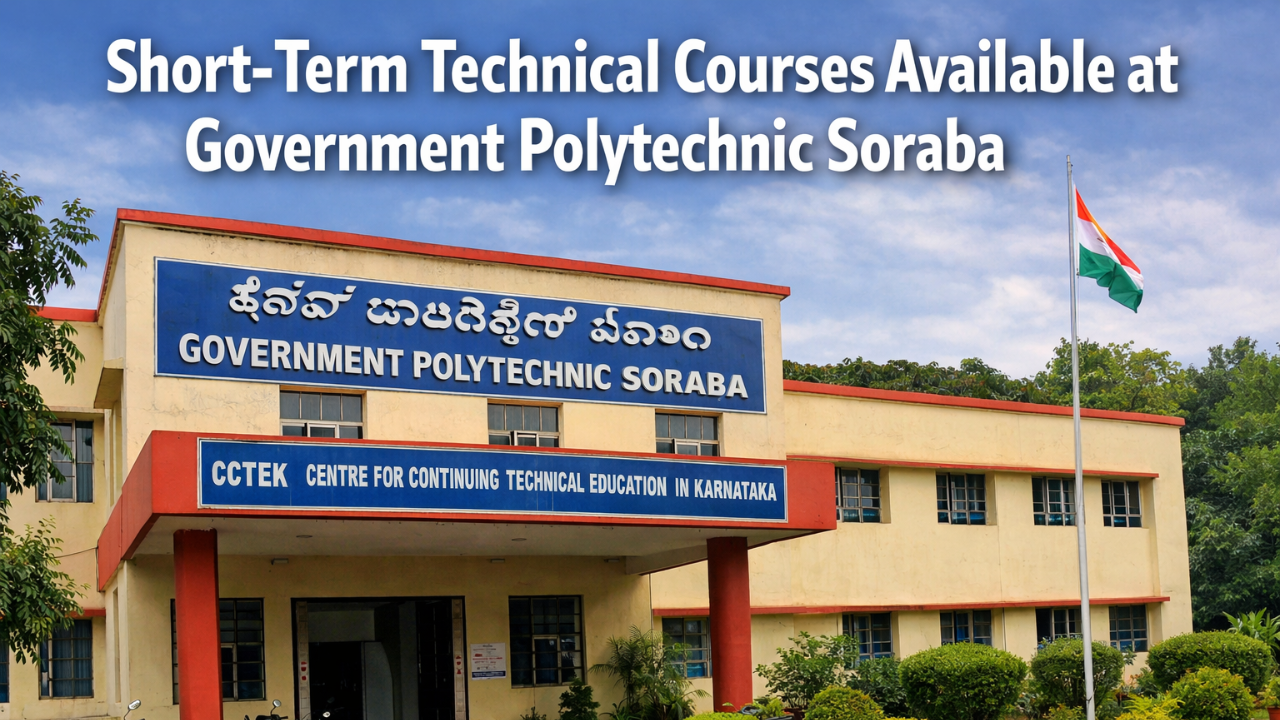
Government Polytechnic Soraba offers diploma programs in multiple engineering and technical streams at an affordable cost compared to private institutions. As a government-run polytechnic in Karnataka, the fee structure is regulated by the state technical education authorities, ensuring uniform and minimal tuition charges. Understanding the course-wise fee details helps students and parents plan finances effectively before admission.
Table of Contents
Fee Overview
Fee Structure Summary
| Course Name | Duration | Approx. Total Tuition Fee (3 Years) |
|---|---|---|
| Diploma in Civil Engineering | 3 Years | ₹12,000 – ₹15,000 |
| Diploma in Mechanical Engineering | 3 Years | ₹12,000 – ₹15,000 |
| Diploma in Computer Science Engineering | 3 Years | ₹12,000 – ₹15,000 |
| Diploma in Electronics & Communication | 3 Years | ₹12,000 – ₹15,000 |
| Diploma in Electrical Engineering | 3 Years | ₹12,000 – ₹15,000 |
| Diploma in Commercial Practice | 3 Years | ₹12,000 – ₹15,000 |
The above tuition fees represent the approximate total cost for the full three-year diploma program. Exact figures may vary slightly depending on government revisions for the academic year 2026.
Tuition Components
Tuition fees in the Government Polytechnic Soraba generally include core academic charges such as classroom instruction and laboratory usage. Government polytechnics follow standardized fee norms set by the state’s technical education department, which ensures affordability for students from all economic backgrounds.
Apart from tuition, students may need to pay additional institutional charges during admission. These may include registration fees, examination fees, and small development fund contributions. However, these costs remain significantly lower than those of private polytechnic institutions.
Civil Engineering
The Civil Engineering diploma focuses on construction technology, structural design basics, surveying, and project management. The fee structure for this course aligns with other engineering diplomas and remains within the general government-prescribed range.
Students pursuing Civil Engineering may incur minor additional expenses for field visits, surveying instruments, and drawing materials. Despite these small supplementary costs, the overall financial burden remains manageable compared to private colleges.
Mechanical Engineering
Mechanical Engineering diploma covers machine design, workshop practices, thermal engineering, and manufacturing technology. The tuition cost remains similar to other diploma branches in the institute.
Workshop-related courses sometimes require safety equipment or materials for practical training. These costs are usually minimal and often supported through lab fees included in the general tuition structure.
Computer Science
Computer Science Engineering diploma emphasizes programming, networking, database management, and software fundamentals. The fee structure remains consistent with other streams, making it one of the most affordable technical courses in the region.
Students may choose to invest additionally in personal laptops or software tools to enhance learning. However, core laboratory facilities are provided by the institution within the tuition framework.
Electronics Communication
The Electronics and Communication diploma includes subjects like digital electronics, communication systems, microprocessors, and circuit design. The tuition remains uniform across engineering branches under state guidelines.
Practical training in electronics labs is included in the academic fee. Minor expenses for project components or electronic kits may arise during final-year projects, but these are generally affordable.
Electrical Engineering
An electrical engineering diploma covers power systems, electrical machines, wiring, and renewable energy basics. Fee levels are aligned with other diploma programs offered at the polytechnic.
Students may need basic electrical tools or project materials during practical sessions. These costs are relatively low and do not significantly increase the overall course expense.
Commercial Practice
Diploma in Commercial Practice is a non-engineering program focusing on business communication, accounting, office management, and computer applications. The fee remains comparable to engineering diplomas.
This course typically requires minimal lab-related expenses, making it one of the most economical programs offered at the institute.
Additional Charges
- Admission and registration fees (one-time payment).
- Examination fees per semester.
- Library deposit (refundable).
- Caution deposit (refundable at course completion).
- Hostel and mess charges (if applicable).
Hostel expenses vary depending on accommodation type and food facilities. Students opting for day scholar status avoid hostel-related charges entirely.
Scholarship Benefits
Students belonging to SC/ST and OBC categories may receive tuition reimbursement or fee concessions under the Karnataka government schemes. Economically weaker section students may also qualify for scholarships or maintenance allowances.
These benefits significantly reduce the effective cost of education. Eligible students should apply through official scholarship portals to maximize financial assistance.
Cost Comparison
Compared to private polytechnic institutions where diploma fees can exceed ₹40,000–₹80,000 for three years, the Government Polytechnic Soraba offers highly economical education. This affordability ensures wider access to technical training for rural and middle-income families.
Lower tuition fees combined with government scholarship schemes make the institution financially accessible without compromising educational standards.
Financial Planning
Students should budget for tuition, examination fees, study materials, transportation, and optional hostel costs. Creating a semester-wise expense estimate helps families manage finances smoothly.
Exploring scholarships, fee reimbursements, and installment payment options further eases financial pressure. Early preparation ensures uninterrupted academic progression throughout the three-year diploma course.
Closing Reflections
Government Polytechnic Soraba maintains a transparent and affordable fee structure across all diploma courses, with total tuition typically ranging between ₹12,000 and ₹15,000 for the entire three-year program. Additional minor charges may apply, but overall costs remain significantly lower than private institutions. With government scholarships and fee concessions available for eligible students, the institute provides a cost-effective pathway to technical education and skill development in Karnataka.