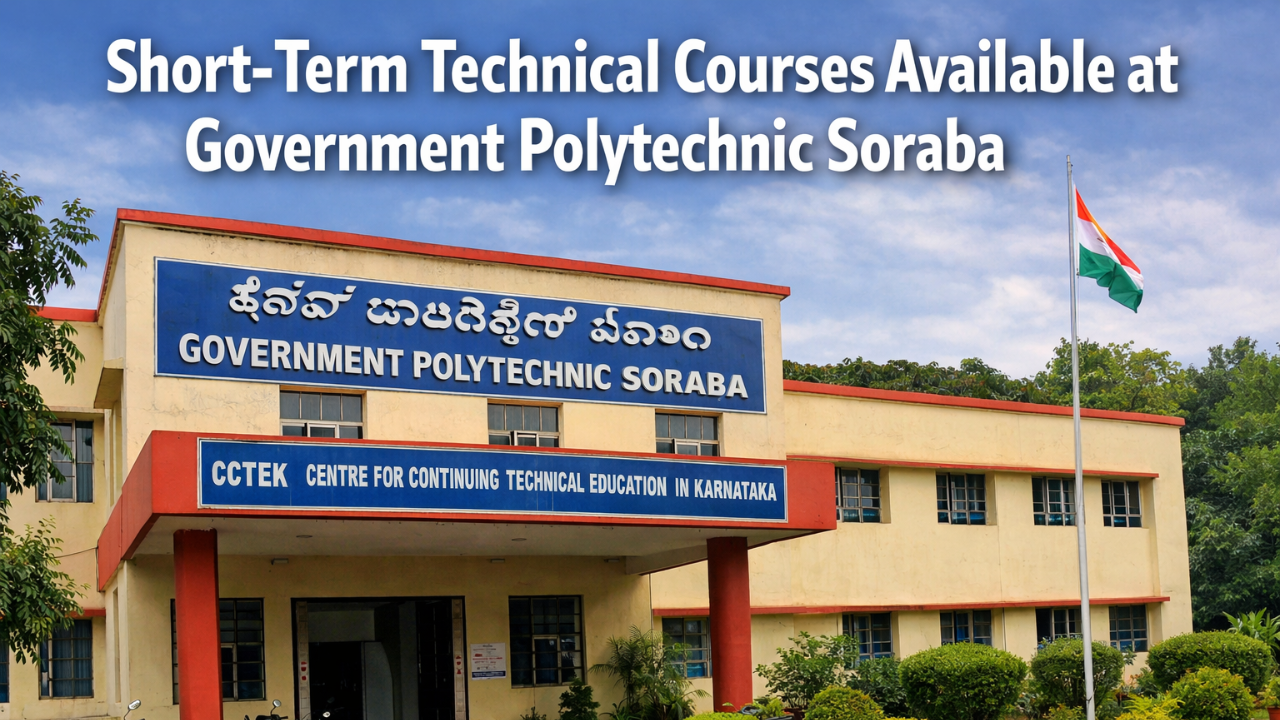
Understanding the semester exam pattern and evaluation system at Government Polytechnic Soraba (Karnataka) is crucial for diploma students to plan their studies, prepare effectively, and score well throughout their academic course. Polytechnic diploma programmes are structured semester-wise, with a combination of internal assessments and semester exams that together determine a student’s final grade. This article explains how exams are organised, how marks are allocated, and what evaluation norms students should follow in 2026.
Table of Contents
Overview Snapshot
Exam & Evaluation Summary
| Component | Purpose | Weightage |
|---|---|---|
| Internal Assessment | Continuous evaluation | 30% |
| Semester Examinations | End-of-term theory | 70% |
| Practical Exams | Lab skills & experiments | Varies by subject |
| Attendance Requirement | Minimum attendance | 75% (approx.) |
| Passing Criteria | Minimum marks to pass | 40% – 50% |
Semester Structure
Diploma courses at Government Polytechnic Soraba follow a six-semester system spread over three years. Each semester typically includes:
- Theory Subjects: Core subjects relevant to the engineering stream.
- Practical Sessions: Laboratory and workshop classes focusing on hands-on skills.
- Projects & Assignments: Field work or mini-projects to demonstrate applied knowledge.
- Industrial Training: Some semesters integrate industry exposure or training modules.
The semester evaluation system measures both theoretical knowledge and practical competency to produce a balanced academic assessment.
Internal Assessment
Internal assessment accounts for continuous evaluation throughout the semester. It includes:
- Class Tests: Regular unit tests that check understanding of recent lessons.
- Assignments: Home or class assignments based on theory or practical topics.
- Quizzes/Surprise Tests: Short tests aimed at tracking consistent learning progress.
- Practical Records: Laboratory notebooks assessed on accuracy and completeness.
Internal assessment usually carries 20–30% weightage of the total marks for each subject. These marks are submitted to the board or affiliating technical education authority at the end of the semester.
Semester Examinations
Semester examinations are held at the end of each academic term and mainly test the theoretical understanding of subjects. Key features include:
- Duration: Typically 2–3 hours per paper.
- Question Pattern: A mix of short-answer questions, long-answer questions, and problem-solving questions.
- Syllabus Coverage: Entire syllabus for the semester’s subjects.
The semester exam generally carries around 70% weightage of the total marks for each theory paper, making it the most significant component of the overall evaluation.
Practical/Sessional Exams
Practical exams assess students’ hands-on skills and are conducted by internal and external examiners. Components include:
- Lab Performance: Execution of the experiment with proper procedure.
- Viva-Voce: Oral questioning based on experiment and theory.
- Record Book Assessment: Evaluation of written observations and conclusions.
Practical evaluation may carry a separate mark range, depending on the subject and semester. For example, a subject with both theory and practical components might have 70 marks for theory and 30 marks for practical.
Attendance Requirement
To appear for semester examinations, polytechnic students must satisfy minimum attendance norms. While exact percentage criteria can change, a common standard is:
- 75% attendance in each subject and practical class.
Students failing to meet the attendance requirement may be detained from appearing in final exams, requiring extra effort to clear eligibility.
Passing Criteria
Passing requirements usually include:
- Minimum Marks: Students must score a minimum of 40–50% in each theory and practical component to pass a subject.
- Aggregate Score: Total combined internal + semester exam marks must meet minimum eligibility for promotion to the next semester.
- Improvement Exams: If a student fails or wants to improve their marks, supplementary or re-examination opportunities may be available.
Failing a subject can delay progression to the next semester until cleared.
Grade/Marks Declaration
After exams:
- Answer Scripts Evaluation: Conducted by internal faculty or external examiners appointed by the technical education board.
- Result Publication: Results showing marks and grades are published on the college or board portal.
- Marksheet Issuance: Official semester marksheets are provided to students for record-keeping.
Grades may be awarded based on overall performance following norms set by the affiliating technical board.
Project Evaluation
In the final semesters, students may be evaluated for project work, which includes:
- Project Report: Submission of documented project work.
- Presentation/Viva: Oral defence of the project before an evaluation committee.
- Industrial Training Assessment: Practical exposure reports, if applicable.
Project evaluation carries its own marks and contributes to the final semester result.
Re-Examination/Supplementary Exams
If a student is absent, fails, or wants to improve their marks, they can apply for:
- Supplementary Exams: Held after regular exam results.
- Revaluation (if available): Request for rechecking answer scripts.
Students must pay the required fees and meet deadlines to appear for these exams.
Continuous Assessment Importance
Internal assessment is not just a marks component but also:
- Encourages consistent study habits.
- Ensures students engage with the syllabus throughout the semester.
- Reduces pressure in final term exams by diversifying evaluation.
Teachers monitor class performance, attendance, and assignment quality for internal scoring.
Academic Calendar Alignment
Exams follow a set academic calendar released at the start of the session, including:
- Starting and ending dates of semesters.
- Dates for mid-term tests, practicals, and final exams.
- Holidays, class schedules, and study breaks.
Students should mark important dates early to plan revision cycles.
Evaluation Transparency
Evaluation practices usually include:
- Standardised marking schemes across subjects.
- Clear rubrics for practical and theoretical evaluations.
- Transparent result publication timelines.
Students can approach the faculty or the exam cell for clarification on scores or discrepancies.
Improvement & Skill Development
To support performance growth:
- Remedial classes are organised for weak areas.
- Extra practical sessions help strengthen hands-on skills.
- Peer study groups and faculty guidance improve conceptual clarity.
These academic efforts enhance competitive readiness for exams.
The Way Forward
The semester exam pattern and evaluation system at Government Polytechnic Soraba focus on both continuous internal assessment and end-of-term evaluations to ensure well-rounded academic measurement. By balancing theory, practicals, projects, and attendance requirements, the system not only tests knowledge but also encourages consistent performance, skill development, and academic responsibility — preparing students for further studies and professional challenges ahead.